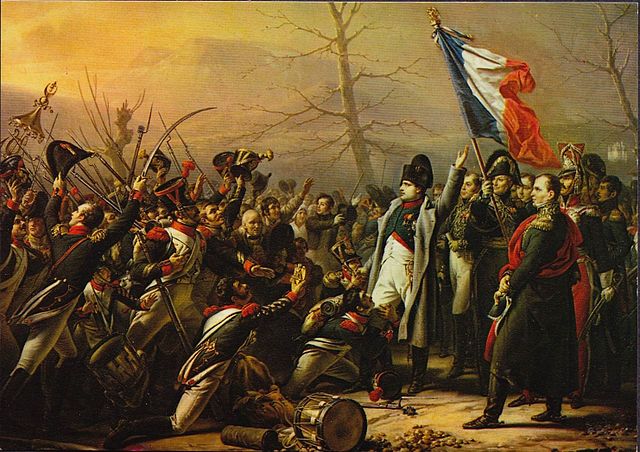

The Retreat from Moscow in 1812 was the catastrophic withdrawal of Napoleon’s Grande Army from Russia, signalling the beginning of the end for Napoleon’s campaign to conquer Europe. A retreat is supposed to save your army from disaster, not so the Retreat from Moscow.
I’m Rick R Dean, and I’m an historical fiction author. My novel, You Met Your Father at Vyazma, is set within the 1812 Retreat from Moscow.
TL;DR
- Napoleon was using a trading ‘boycott’ to starve Britain into submission.
- Russia went against Napoleon and started trading with Britain.
- Napoleon invaded Russia to punish it for flouting his rule.
- He managed to take Moscow, but it had been abandoned and burned down by a ‘scorched earth approach’ from Russia.
- The retreat was too late, with winter weather, lack of supplies and Russian aggravation decimating Napoleon’s army.
- Napoleon’s forces struggled to return to its former ‘unbeatable’ glory after this.
What Was The Retreat from Moscow 1812?
To understand the Retreat from Moscow, you must first understand why Napoleon’s army was there in the first place. Napoleon had big ambitions, and an equally big army.
How the Continental System Triggered Conflict with Russia
Napoleon and the French defeated the powers of Europe one by one. They were old established kingdoms with paranoia over the new thinking of the revolution, and were brought into check by France very successfully.
The only opponent that they couldn’t defeat was Great Britain. After the Battle of Trafalgar in 1805, France’s maritime ambitions were essentially nullified – Britannia ruled the waves. The only option was to make economic war on Britain, which needed to trade with the continent. And so Napoleon forbade the newly conquered nations from trading with Britain in his ‘Continental System’.
This worked until Russia started to flout it. Napoleon didn’t approve, and decided to teach the young Czar Alexander a lesson. He gathered a massive army at the Russian frontier in the early part of 1812.
The Grande Armee Pushes Towards Moscow
The Czar ignored and avoided him. So Napoleon invaded Lithuania, the first province in Russia. His intention was to catch the poorly maintained, cumbersome Russians there and inflict a defeat on them, which given the capability of his men in the last few years was entirely plausible and likely.
However the Russians (who in the light of later events claimed it was all deliberate) retreated so fast he couldn’t catch them. In a series of errors, Napoleon, desperate to defeat them, found himself further and further into the hostile hinterland of Russia, the western approach to Moscow.
The Russian Commanders Peter Bagration and Barclay De Tolly initially distrusted each other, which gave Napoleon the encouragement to pursue deeper into Russia. However, at Smolensk, they joined forces. Napoleon, too far in, decided to pause, in late August of 1812. It would perhaps have been prudent, but not satisfactory, to wait until spring and continue the campaign, but Napoleon decided to pursue the Russians anyway. The Czar put an overall Commander, Field Marshall Kutusov in charge over the bickering Generals, who saw that Napoleon would be on their doorstep imminently.
The Battle of Borodino: A Stalemate
At Borodino, the two sides slugged it out. It was the bloodiest single day of the Napoleonic wars, with total casualties estimated between 70,000 and 80,000. Technically a tactical victory for Napoleon, strategically, he was left the weaker of the two sides.
The Russians limped away to recoup, leaving Moscow for Napoleon. By October, he was installed in the Kremlin, thinking the Czar would sue for peace. It didn’t happen. Instead, the city burned.
Napoleon and his army had to leave.
Why The Retreat from Moscow Became Catastrophic
The retreat from Moscow decimated Napoleon’s army, with fewer than 50,000 soldiers of 600,000 strong surviving. Here’s why:
The Russian Strategy
As the Russians withdrew from Napoleon, they destroyed crops, villages and food supplies, so the French army had no way to feed themselves.
When Napoleon started to retreat, Russian cossacks started to constantly harass the slow-moving, starving army, picking off stragglers.
The Winter
The Russian winter is not to be trifled with at the best of times, but this one was early and harsh. The temperatures got as low as -30℃.
Disease
Disease was rife. Paratyphoid fever and louse-born fever spread amongst the grand army, bringing fever, fatigue and digestive problems.
Breakdown of Discipline
The retreat turned into an ‘every man for himself’ scenario, with soldiers fighting each other for resources.
Why the Moscow Retreat Matters
The Retreat from Moscow is important because it was the first nail in the coffin to the ultimate defeat of Napoleon. For the first time, it signalled to the rest of Europe that he wasn’t invincible.
Until the invasion of Russia, the Grand Armée had been virtually unbeatable. Between 1805 and 1809, the French
The Turning Point in Napoleon’s Downfall
The retreat did for Napoleon, his Empire and any realistic ambitions for reinstating it. The Battle of Waterloo is normally given this accolade, and it certainly is the last battle and final defeat of Napoleon, three years after the Moscow debacle. And there is no belittling the achievement of Wellington, his army and the loyal allies, Prussia, Hanover, Brunswick, Nassau, Holland and Belgium.
The Grand Army that invaded Russia was in effect, unbeatable on the battlefield. The prime units, which inflicted devastating defeats on Austria, Prussia and Russia between 1805 and 1809, all disappeared in 1812.
Napoleon and his brilliant Marshals did survive, and they kept going until 1814 with new recruits. Hounded by the allies, Napoleon abdicated in May of that year. The hundred days, Napoleon’s last campaign culminating at Waterloo, did not succeed due to many factors, but one was that his army wasn’t the undefeatable, pre-1812 army.
If one was to put that army against the British at Waterloo, I personally believe the outcome would have been different. Consider the opening attacks, at Borodino by Davout, and d’Erlon at Waterloo. In 1812 Davout’s men rolled up to the dug in Russians a dozen times before they kicked Stroganoff’s Grenadiers out of their earthwork redoubts and succeeded in their objective. D’Erlon’s men had one go and left it at that.
After Waterloo, there was peace in Europe apart from the odd scuffle, for the next century. If it wasn’t for the peace, which allowed the Industrial Revolution to flourish, the Europe we live in today would be very different.
Why I Wrote About The Retreat from Moscow in My Novel
I was channel surfing one evening and came across a documentary about an archaeological excavation near Vilnius in Lithuania. They were excavating the remains of soldiers and civilians who had been caught up in Napoleon’s invasion of Russia in 1812, and could tell what nationality they were, mainly French, from the remains of uniforms still existing on them. They went on to say that there were people living in towns and villages along the route of the retreat with French and other European, not Russian Surnames. So, many of the stragglers stayed in Russia and had families, and so their descendants live to this day.
I have always been fascinated by relative value. A man with £1 to his name, who buys a cup of soup from a charity for 10p, is investing 10% of his worth. A man with a million pounds buys a £100,000.00 car, is investing the same, 10%. A cup of soup or a hundred thousand pound car, very different amounts of money, but the same value to the recipient.
I looked into the Retreat from Moscow; Napoleon’s men left the Russian capital with a few flour cakes, a few days ration at most, but also weighed down with gold, jewels and artefacts looted from the big houses. Soon the only thing of value was food, so they cast away gold and rubles at the side of the road because they couldn’t eat them. They were worth a lot of money, but had no value. Those peasant soldiers inevitably thought they would bury those riches, to return some day and recover them. However, they would perish later in the snow, never to return.
I read further and found that there was a large number of women who went with the Grand Armee into Russia, and their children. Many were wives, but also cantinieres and vivandieres, women who were paid by the army to provide food, tobacco, alcohol and other supplies. Eyewitness accounts generally agree that these women bore the hardships of the retreat better than the men. But how, I thought, would a pregnant woman cope?
In my novel, You Met Your Father at Vyazma, a French Officer forbids his wife to come with him, but he doesn’t know she is newly pregnant. They have had several miscarriages, so she doesn’t want to disappoint him, but she also has a dark secret involving her husband’s subordinate Officer, who is now with him. She travels to Russia to tell him the good news, but also to confess. However, in the background the campaign starts to go seriously wrong, and events overtake them.